
The multifaceted nature of information, with the concept appearing in different guises in a variety of domains, from the physical to the social, has been the subject of increasing interest in recent years, with the emergence of a range of unifying theories of information. In this short post, I mention some publications on the topic which have appeared in 2026.
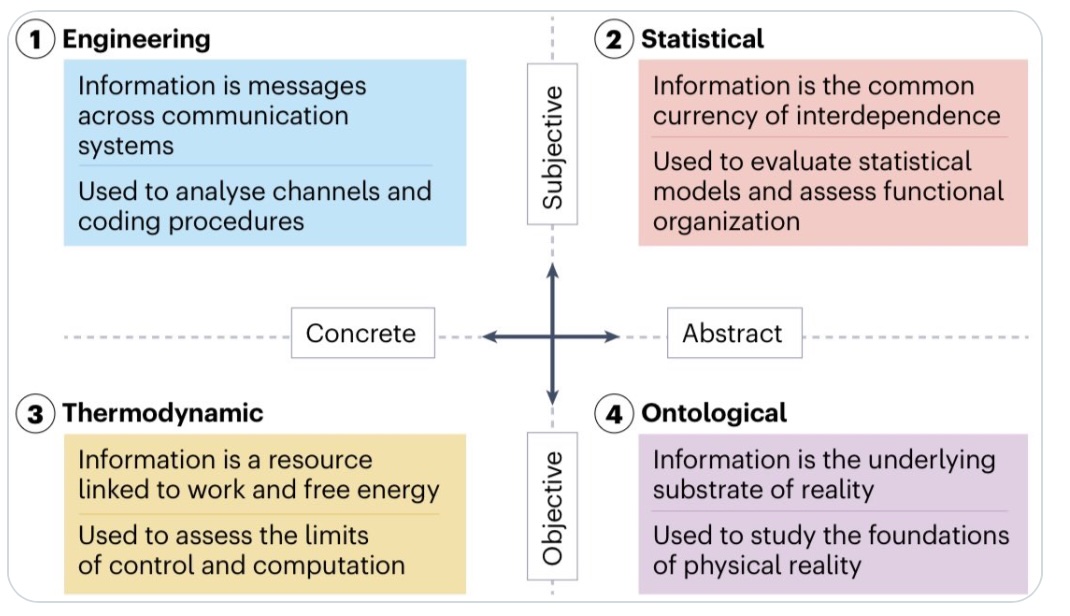
The latest overview comes in the form of an excellent new review article, with supplementary material for more technical aspects, dealing with the historical development, and the latest views, of the concept of information in the physical world (Rosas et al., 2026). Entitled ‘Four faces of information in natural systems’, the review comes from an impressive multidisciplinary group of authors. From the journal in which it is published, Nature Reviews Physics, one may guess, correctly, that ‘natural systems’ refers almost exclusively to the physical world, although there is some mention of the extension of the ideas to topics within biology. Given this scope limitation, understandable in keeping the review to a acceptable length and logical structure, the authors note the writing of Luciano Floridi, among other philosophers, as the inspiration for seeking a pluralistic approach to information: “the complementarity of distinct, yet equally valid applications of an information lens for natural systems”. There is a focus on an attempt to reconcile, for physics at least, the dichotomies around information concepts. Information is interpretable in both objective and subjective terms, and is equally interpretable as either an encapsulation of structural properties of nature, or as a tool for reasoning about the physical world while not itself being a part of it.
The ‘four faces’ of information which are used to structure the review are:
- engineering – information as referring to messages carried or stored across communication systems.
- statistical – information as the common currency of interdependence, serving as a tool to reason about statistical models
- thermodynamic – information as component of, and resource within, physical systems
- ontological – information as a fundamental and irreducible building block from which other entities and phenomena can be explained. The authors comment that, for all its attractiveness as a strikingly new physical perspective, this face of information is “still more of a research programme than a fully spelled-out proposal”.
The authors make cogent and, to me at least, novel points for all these faces. I noticed two points, in particular, which emphasise that this is still a contested topic.
In the thermodynamic face, there is still a paradoxical element, in that, while physical entropy of any closed system increases with time, information entropy may decrease, as our knowledge of a system increases. It may, the authors suggest, be possible to construct a new version of the second law of thermodynamics to solve the paradox; but it is a striking example of the difficulty of reconciling objective and subjective accounts of information.
In the ontological face, the authors point out that the “it from bit” concept, now commonly taken to mean that it is possible to understand all of physics in terms of information, originally had another perspective. Rather than a way of understanding the basic nature of the universe, it emphasised the role of discrete (yes/no) measurements in the Copenhagen interpretation of quantum mechanics. This is a good example of the need to carefully assess the, potentially changing, implications of slogans such as “it from bit” and “information is physical”.
The authors arguably hedge their bets in their conclusions, saying that “the ultimate future of physics is hard to predict; in the meantime, we suggest recognizing the usefulness of information for capturing important aspects of reality, whether or not there is something more to it than that.”
As noted earlier, the scope of the review is restricted to the physical world, with some implication for biology. This is not the wide-ranging perspective of a Stonier, Brenner, or Hofkirchner. It would however be churlish to complain of a lack of scope, and an undue caution, in the writing of this review. Within its stated limits, it gives a thorough and accessible account of the state of the art, and will be very useful to anyone embarking on study of the area. The authors’ hope “that this framing may contribute to a robust development of information-based frameworks in physics and beyond” is likely to be realised, even if it will certainly need extending to the “beyond”. Shannon’s words from 1956, quoted by the review authors, are certainly relevant here: “many of the concepts of information theory will prove useful in these other fields […] but the establishing of such applications is not a trivial matter of translating words to a new domain, but rather the slow tedious process of hypothesis and experimental verification”.
Several papers have appeared during 2026, arguably progressing this slow process of understanding information in different domains and contexts.
An article by Bethany Terris in Foundations of Physics develops the idea of an ‘informational observers’ in quantum mechanics; specifically, in the Relational Quantum Mechanics (RQM) interpretation, introduced by Carlo Rovelli in 1994 as an alternative to more traditional interpretations of quantum theory such as the Copenhagen interpretation, Everett’s many-worlds conception, or de Broglie-Bohm pilot wave theory. The basic idea underlying RQM is that the quantum state does not provide an absolute description of a system; it provides instead a relational description, with states are defined relative to another system that functions as an observer. Rovelli’s original RQM deliberately avoids requiring observers to be conscious entities; any physical system, whatever its size or complexity, can be an observer, provided only that there be some interaction with the system being observed.
Terris points out that this is not is not in accordance with what would normally be regarded as observation in the philosophy of science, and that it can lead to lack of clarity amounting to a paradox in some cases. Terris conceives of an observer as a complementary two-part physical and informational structure. An observer is “more than a physical system that records facts. It is a system whose informational role persists through time”. An observer creates records, which can be integrated into a coherent informational framework capable of supporting comparison, inference, and confirmation across time. This has resonance with the significance of records in Julian Barbour’s ‘timelessness’ conception of physics.
Whether Terris’ conception gains traction remains to be seen, but it is another example of the way in which the subjective/objective duality of information is of importance for the physical sciences.
Sticking with quantum theory, though outside its true home of physics, an article in Quanta Magazine by Elise Cutts reviews findings of seeming quantum effects in biological systems. The article summarises an emerging view among biologists that these findings do not show quantum effects as such at all, but rather that the properties of some biological systems can be modelled by the same mathematical structures that underlie quantum theory. More specifically, complex networks of classical objects, with many interacting parts, display an overall behaviour which mathematically mimics quantum objects. This approach, accounting for quantum-like behaviour by mathematical rather than physical analogy, could help account for the puzzling appearance of quantum phenomena in informational contexts, such as quantum formalisms for information retrieval, and in social science more generally. It also helps to draw a distinction between this kind of careful analysis and what Lyn Robinson, Tia Siddiqui, and I categorised as “loose analogies and metaphors”: a good recent example of the latter being the application of quantum terminology to “non-linear, probabilistic and multi-perspective thinking” in writing for business and management (Deb, Pani, and Ray, 2026).
The way in which ideas of complexity, organisation, and ‘interesting order’ are intertwined with concepts of information and of entropy has been the subject of a previous post; a new paper in Entropy by Ricardo Silva has another try at untangling this seemingly perennial issue. Silva uses a probabilistic framework based on information theory to derive a descriptor for structural identity alongside entropy and information. Entropy and organisation are treated as complementary rather than competing system descriptors. Silva’s framework aims to provide “a foundation for studying how organized structures emerge, persist, transform, and degrade across a wide range of physical, informational, and complex systems”. Again, it remains to be seen how much traction this idea gains, but it is certainly a useful step towards understanding the inter-relations of these concepts.
The continued interest in the concept of information in so many diverse contexts suggests that we will need to consider more than four ‘faces’ of information, to cover all of its instantiations, in physics and beyond.
References
Cutts, E. (2026) Biology might not be quantum, but its math is quantumlike. Quanta Magazine, September 23, 2026. https://www.quantamagazine.org/biology-might-not-be-quantum-but-its-math-is-quantumlike-20260923/
Deb, S.K., Pani, P, and Ray, A. (2026) Words, worlds, and quantum codes: the future of management writing. Chapter 7 of Artificial intelligence and sustainable innovation: next generation management in the quantum age. Patra, A. et al. (eds.). London: CRC Press. https://doi.org/10.1201/9781042036325.
Rosas, F.E. et al. (2026) Four faces of information in natural systems. Nature Reviews Physics 8, 654–666. https://doi.org/10.1038/s42254-026-00971-4.
Silva, R.J. (2006) Beyond Entropy: Organization as the Preservation of Structural Identity. Entropy, 28, 876. https://doi.org/10.3390/e28080876.
Terris, B. (2026) The informational observer in relational quantum mechanics. Foundations of Physics, 56:39. https://doi.org/10.1007/s10701-026-00939-5.


