
“There is grandeur in this view of life, with its several powers, having been originally breathed into a few forms or into one; and that, whilst this planet has gone cycling on according to the fixed law of gravity, from so simple a beginning endless forms most beautiful and most wonderful have been, and are being, evolved.” (Charles Darwin, Origin of Species)
The grass so little has to do / A sphere of simple green / With only butterflies to brood / And bees to entertain. (Emily Dickinson, The Grass)
A light exists in spring / Not present on the year / At any other period / When March is scarcely here. (Emily Dickinson, A light exists in spring)
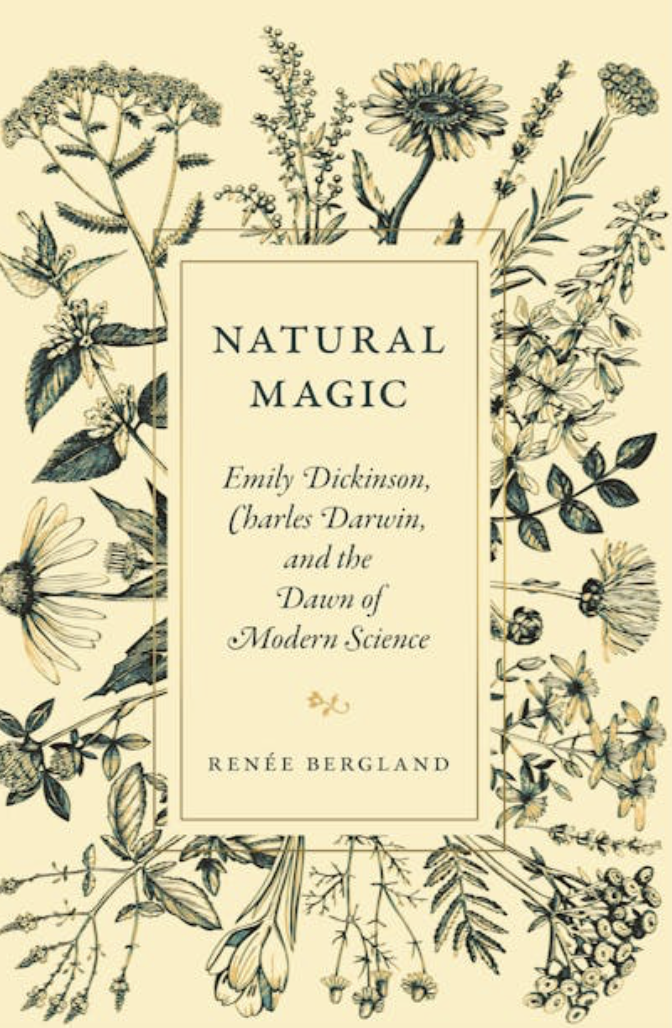
For those who lament the division of academia and scholarship into the arts and the sciences, with a seemingly unbridgeable gulf between them, Natural Magic (Princeton, 2024) by Renée Bergland, professor of literature at Simmons University, offers an insight into a time when this was nor the case. The title of the book comes from the concept of a ‘natural magic’, not involving superstition, still less magic tricks, which underlay the forces of nature and life, and the inter-relations of the elements of the natural world. To illustrate this, Bergland draws parallels between the natural philosophy of Charles Darwin and the poetry of Emily Dickinson, through the early to mid-nineteenth century.
The material to hand to establish the connection is limited. Darwin and Dickinson never met, and never corresponded, and Bergland has to work hard even to find a friend and colleague in common, identifying only the writer and editor Thomas Wentworth Higginson. Dickinson was certainly aware of Darwin, had read his books, and mentioned him in correspondence; but there is no evidence that Darwin ever heard of Dickinson, or read any of her work.
\
With this somewhat unpromising-seeming material, Bergland ekes out a convincing and interesting story, finding a variety of connections between Darwin’s studies and Dickinson’s poetry. Both searched for wonder, enchantment, and mystery in nature: Dickinson more obviously through her nature poems, Darwin through his realisation of wonderful and beautiful life forms generated through evolution.
Some unexpected insights emerge along the way. Dickinson had much more formal training in what would become known as science, including botany, chemistry, and astronomy, than did Darwin. In the New England of the time, women were positively encouraged to study the physical sciences, while men focused on the traditional subjects around the classics and ancient languages. Darwin, studying for the Anglican priesthood at Cambridge, had no formal assessed teaching in the classes available to him. And, while we think of Darwin as a biologist in today’s terminology, he described himself, and was described as a geologist. Geology at that time encompassed much of what we would now call environmental studies, including its biological dimensions, following the pioneering writings of Alexander von Humboldt (‘Personal Narrative’) and Robert Chambers (‘Vestiges of the Natural History of Creation‘).
A deeply researched and scholarly book, which is nonetheless very readable, Bergland’s text brings out some new insights into the origins of modern science, and may help spark ideas for modern views about the interconnectedness of, and relations within, the natural and intellectual worlds.

 The Occasional Informationist