
I have never really liked the seventeenth century; maybe after having to study it at school, seemingly interminably. Rather too much plague, fire, civil war, religious persecution, and Dutchmen doing bad things on the Medway. Yes, of course, Christopher Wren and Isaac Newton, but even so.
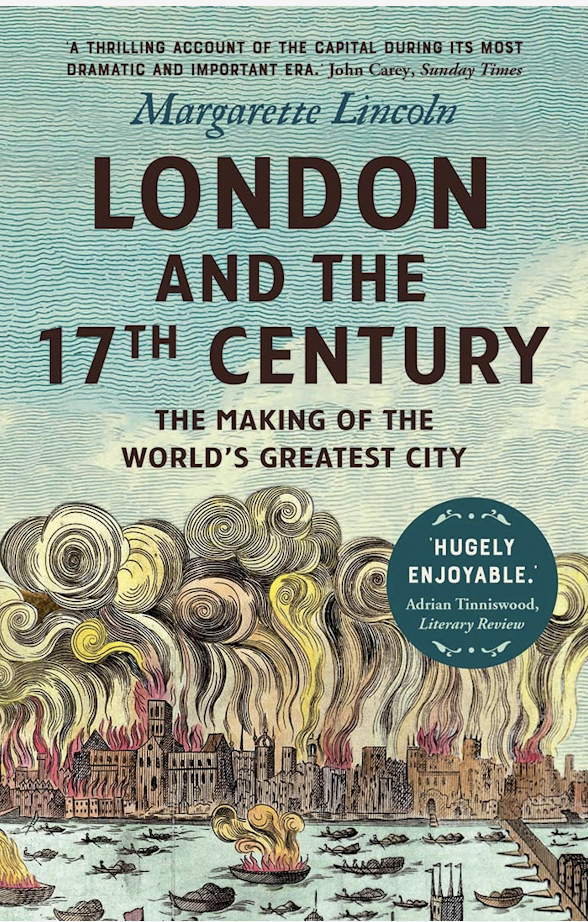
Sometimes, however, reading a single book can change one’s mind, and so it was with Margarette Lincoln’s London and the 17th century: the making of the world’s greatest city (Yale University Press, 2021), which managed to convince me that this century was actually rather interesting, and seminal in the emergence of London as a world city.
Among the points of particular interest to me she covers are: the well-known founding of the Royal Society and the activities of its members, and the perhaps less well-known expansion of Gresham College and its lectures: the growth of the printing trade and the ‘explosion of publications’ in London after the abolition of the Star Chamber in 1641; the expanding number of gardening books and manuals; the significance during the Civil War period of what we would now call fake news; and the development of mathematical approaches to ship design by Henry Biggs, Gresham professor of geometry, a process which had previously relied on the tacit knowledge of almost illiterate master shipwrights.
Highly recommended to anyone with an interest in the history of London, and in the histories of science, and of information.

 The Occasional Informationist